FEATURE: Heat, Memory, Chinatown - Walking Through Yip Yew Chong’s Living Worlds
In Singapore Chinatown, you never just see a mural. You step into it.
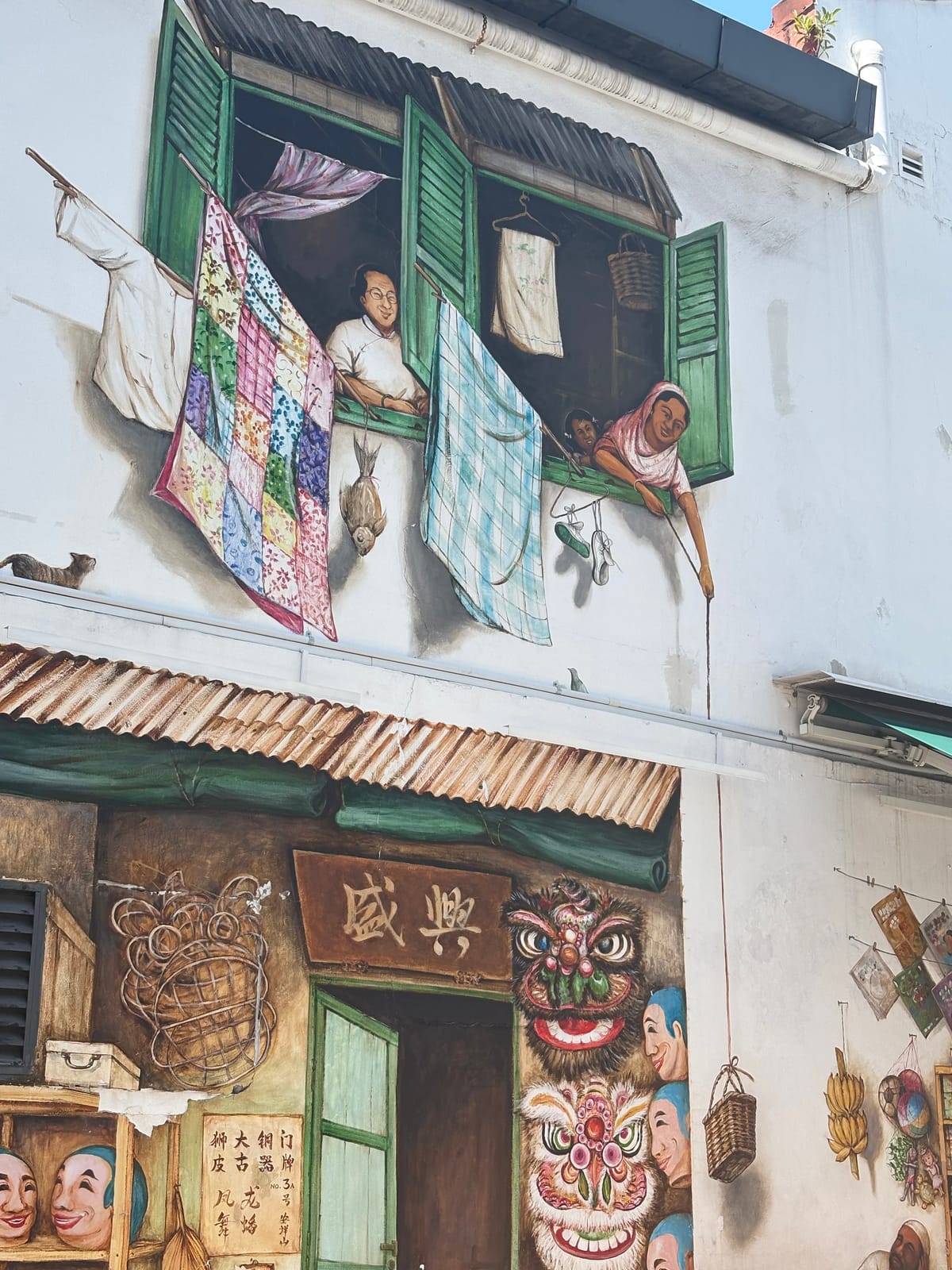
The heat that afternoon was the kind that warps your vision. Not gold, not warm — just a blinding, almost hostile white. It bounced off every tiled roof, seeped into the cracks between shophouses, and settled on my skin like a heavy coat. Even the walls looked like they were sweating.
But Chinatown is a place where weather becomes atmosphere, and atmosphere becomes memory. Heat belongs to the neighbourhood as much as incense, chatter, and the unmistakable smell of frying shallots wafting from a hawker stall you can’t quite see. So I walked — half-melting, half-curious — into Yip Yew Chong’s world.
Because in Chinatown, you never just see a mural. You step into it.
The First Mural: Entering Someone Else’s Yesterday
The first mural I stopped at was one I had seen many times in photos — the Samsui women sitting beside their baskets, the opera masks hanging above them like guardians of old theatre nights. But in person, under the glare of a merciless sun, the painted scene felt oddly alive.
A group of tourists had formed an informal queue in front of it, all waiting to pose. One guy had perfected a “deep squat” he clearly practiced for moments like this. A girl beside him kept adjusting the brim of her bucket hat while muttering about shade. A child tried to touch one of the painted baskets, convinced he could lift it.
My friends took their turn next, sliding effortlessly into the mural’s rhythm. They crouched beside the Samsui women, laughing, mimicking gestures, their real shadows merging so neatly into the painted ones that even my overheated brain did a double take.
And this was the first thing I truly noticed: People don’t behave around Yip’s murals the way they behave around other art.
And maybe it’s because Yip doesn’t paint from imagination — he paints from recognition. His scenes feel like half-remembered dreams of Singapore’s past, the kind families talk about over reunion dinners or while waiting in line for bak kwa.
There’s no reverence, no cautious distance, no “stand behind the line.” People enter the frame and become characters. At that moment, they transform a wall into a living stage. You don’t admire his murals. You join them.
The Instagram Ritual (That We Secretly Accept)
We can pretend that Singaporeans don’t queue for photos, but we do. It’s practically a second national sport.
Everyone around me was negotiating lighting, angles, poses, and the exact number of centimeters between them and the mural. I heard a mother tell her son, “Smile like last time!” to which he replied, “But I wasn’t born last time.” A perfect answer, honestly.
But in watching everyone — tourists, grandparents, teenagers, even my families — another realisation landed: The act of posing is its own kind of participation.
Is it performative? Of course.
Is it meaningful? Sometimes, surprisingly, yes.
In Chinatown, posing becomes a form of recognition. A way of saying, I see this. I feel this. I want to remember this — even if it's just for a moment.
It is not that the mural becomes part of the person — it’s that the person becomes part of the mural.
And in that sense, Instagram hasn’t killed authenticity. It has simply changed how we express it.
Lau Choy Seng: A Mural With Its Real Twin
The walk continued, the heat somehow intensifying. At one point I genuinely wondered if my phone would melt. But then I turned a corner and found myself at one of the most quietly brilliant juxtapositions in the entire mural trail: Yip’s mural of Lau Choy Seng sitting right beside the real Lau Choy Seng.
On the wall: a craftsman, a porcelain shop, nostalgic blues and browns.
In front of it: the actual kitchenware store still selling steel pots, bamboo steamers, metal ladles — the whole hardware symphony of old Singapore.
The façade was so bright I had to shade my eyes with one hand to take a photo. But I didn’t mind. Because the scene itself was an almost perfect metaphor: The painted past and the living present, not fighting each other, but sharing a single wall.
While tourists excitedly posed in front of the mural, the shop owner inside was ringing up sales like he had done for decades. The real business hummed on, unfazed by the digital age.
I realised then that one of Yip’s quietest strengths is this: He doesn’t mourn the past — he layers it.
His murals don’t freeze history; they let it breathe beside us. They remind us that heritage isn’t a museum label — it’s a continuity.
Sometimes painted. Sometimes real. Often both.
Objects That Belong to Everyone
The heat reached its peak at a mural of a grandmother sewing while children played on a rattan bed. The whole scene shimmered gently, as if the past was waving at me through a heat haze.
The other mural has an orange public payphone with “I just called to say I love you” painted above it. A small detail, a huge feeling.
Because some objects in Yip’s murals are more than nostalgia. They’re cultural shortcuts. Emotional timestamps. They make you think of someone even if you don’t know who.
Tin sewing kits. Enamel cups. Rattan furniture. Bread tins. Plastic stools. The smell of Tiger Balm.
Everyone in this part of the world has seen these things somewhere — in a grandparent’s home, a kopitiam, an old rental flat, a market stall, a childhood memory they didn’t even realise they had.
They’re not personal memories. They’re regional ones.
And that’s why Yip’s murals work so well: They don’t tell you what to remember. They make you remember something anyway.
Heatstroke, Photos, and the Blur Between Art and Life
By the time I reached the last mural, I was drenched. My phone was overheating. My thoughts were slowing down. Chinatown had baked me into a slightly delirious, deeply reflective state.
But when I sat later and scrolled through my photos, I saw something I didn’t notice while walking: In every picture, the boundary between mural and life was soft. Blurry. Porous.
People interacted with the walls as if they were doorways. Locals passed them without ceremony, the way you walk through your own house. Tourists used them as backdrops, props, portals.
And through all of this, the murals stayed patient — absorbing, reflecting, witnessing. Chinatown isn’t a museum. It’s a living script.
Yip’s work simply writes the parts we forget.
Why These Murals Matter
It’s easy to think murals are just “pretty things on walls.” But they’re more than that — especially in a city that changes faster than hearts can follow.
Yip’s murals matter because they remind us that:
- memory can be public
- belonging can be shared
- heritage can be sweaty, noisy, messy, alive
- art doesn’t need grand spaces to mean something
- ordinary stories have extraordinary staying power
Under that scorching, unforgiving sun, I realised something simple:
The past isn’t behind us. It walks beside us — glowing faintly through the heat.
And in Chinatown, every mural by Yip Yew Chong is an invitation: Come in. Sit. Remember something you didn’t know you remembered. Because here, art doesn’t wait for you. It catches you as you walk by.